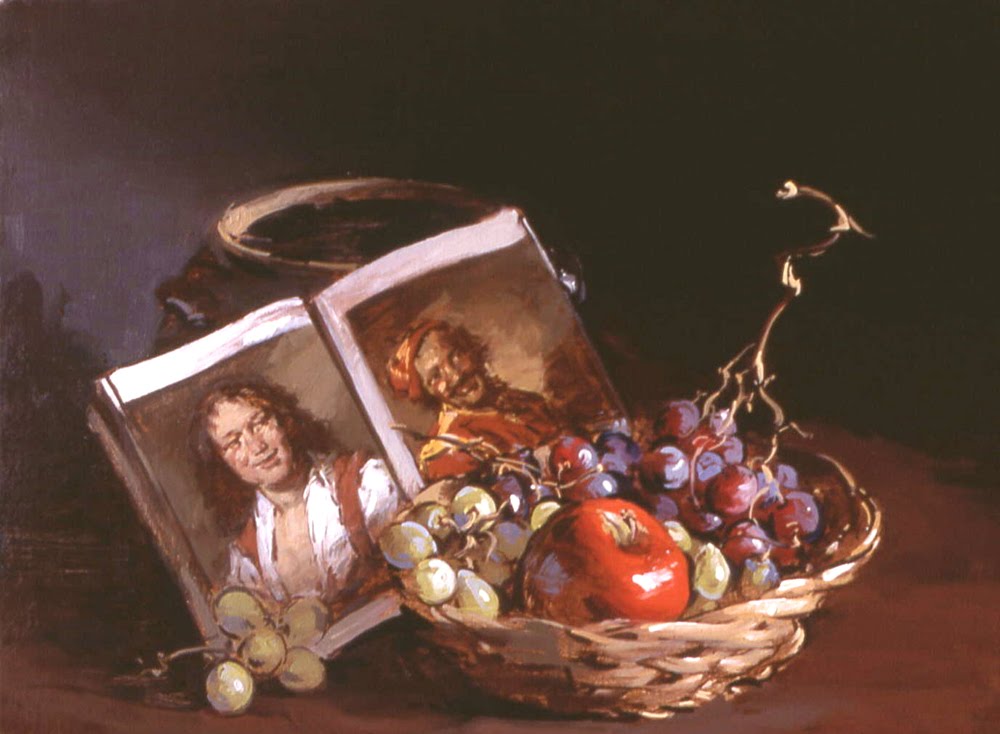
Artistic experiences: part 6, Mason’s class
I soon found out I wasn’t the only League student working at Carnegie Hall. Several of the ushers were artists too and we became fast friends. After the evening’s concert was over 4 or 5 of us would go across the street to Carney’s bar and talk for hours over a few pitchers of beer. They had been in New York longer than me and I was anxious to hear what they had to say. The conversation was not just about painting, although there was plenty of that, but also about music and philosophy, politics and history. These were not a bunch of dopey social misfits, as artists sometimes are, they were highly intelligent, well educated and fascinating. I was impressed by their conversation and, even though I had yet to see their work, wanted to know who they were studying with. They all had the same answer, Frank Mason. I knew Mason’s work from an article in American Artist magazine and his full length standing portrait in the League’s Instructors Exhibition was my favorite in the show. They introduced me to their mentor and I signed up for his class without hesitation. My first critique was a little embarrassing but very profound for me. Mason’s class was so popular that it spilled over into a second room. Because I was starting in the middle of the week I had to find a place to paint wherever I could. Both rooms were packed and there was no place for me to set up where I could see the model so I set up near the doorway, opposite the skylight, and started a painting of a plaster cast of Donatello’s David. Mason showed up the next day, quickly glanced at what I was doing, then said “turn your easel around so you can get more light on your painting and get yourself a hat so you won’t be blinded by the skylight. Now follow me around and watch the other crits, you’ll learn much faster that way.” It only took 10 seconds but it was extremely important to me, I was being taken seriously as an artist…..
Drawings and paintings in varying states of completion by Thomas Torak with comments, observations and musings by the artist. All images on this blog are copyrighted and cannot be reproduced without permission.
Wednesday, September 1, 2010
Sunday, August 29, 2010
Studio Interior Artistic experiences: part 5, the League
Five days before my 21st birthday I left my old life behind and started my new life. With all my possessions in two large suitcases I boarded a train for New York and checked into the 63rd Street YMCA. I knew I had to find a job and an apartment but the first thing I did was register for a class at the Art Students League. I purchased a big newsprint pad and some vine charcoal, headed up to the second floor, found an empty chair and started to draw. I never felt more alive. As the weeks passed by I found a place to live and got a job working at a concession stand in Carnegie Hall, half a block from the League. I would visit galleries and museums in the morning, draw at the League in the afternoon and listen to the concerts while I worked in the evening. My cultural life was definitely improving. The instructor in my first class was nice enough but more encouraging than instructive. I was hungry to learn and switched to Hale’s anatomy class. Robert Beverly Hale was a legendary anatomy teacher and I drank in as much as I could. I couldn't learn fast enough. I practiced drawing boxes of all sizes and lighting them from different directions. I worked hard on shading forms from light to dark and drawing lines that went around those forms. Soon I found myself reading and copying out of anatomy books at midnight when I got home from work. During the breaks in my drawing class I would wander around the League poking my head into the painting classes. I knew I had to improve my drawing skills but I was eager to paint…..
Thursday, August 26, 2010
Silver and Gold Artistic experiences: part 4, art school.
No one ever told that me that I could make a living as an artist, but then again no one ever told me that I couldn’t. In fact I never discussed it with anyone. After my friends went away to college I got a job in one of the local factories. I decided to try to learn something about painting at night and sent away for the Famous Artists School painting program. I would produce a picture according to the lesson plan and mail it to the school, an artist at the school would correct my picture and mail it back to me. It didn’t take long for me to realize that this was no way to learn how to paint so after 3 lessons I became a mail order art school dropout. It did make me aware of how much I wanted to get started painting. So I did some research and sent away for information from every art school I could find in the country. They were all pretty much the same. There was a prescribed course where you learned drawing, painting, sculpture, printmaking, photography, etc, etc, etc. And they were all expensive. Then I received the catalog from the Art Students League. The work by the instructors was better than at any of the other schools. At the League you pay a small amount per month and choose what classes you want to take. No prescribed course, no papers to write, no grading, no degree program. No portfolio to present for admission, I could just show up and learn to paint. I knew immediately where I was going…..
Tuesday, August 24, 2010
Artistic experiences: part 3, the museum.
While visiting the home of one of my high school friends I saw two pictures on the wall which moved me very profoundly. I looked for them in the art books at the library the next day and found one was Rembrandt’s Girl with a Broom, the other was Frans Hals’ Bohemian Girl. They were cheap reproductions but a spell had been cast. Shortly after graduation I took myself to the Philadelphia Museum of Art. As far as I knew no one in my family had ever been to a museum, neither had any of my friends. In my uncultured world I was sailing into uncharted waters. I started up the enormous stairs leading to the museum, it seemed as if I were climbing Mount Olympus. I was in fact about to enter what would become for me the home of the gods. The first room I entered housed an early Renaissance altar, quite beautiful but I came to see paintings. The next room did not disappoint. I entered and stood before Rubens’ Prometheus Bound. I was frozen in my tracks. I had never seen or experienced anything like this before. A 7’ x 8’ tour de force with Prometheus tumbling out of the canvas while an eagle swoops in to peck at his liver. I had never perceived anything so terrifying and yet so beautiful, so powerful, expressive and compelling. I was unaware of my surroundings, nothing existed for me except this painting. My heart was pounding, my head swimming, I was transported to another dimension. I’m not sure how long I stood there but I knew my life had changed. At that moment, though I had not yet touched a canvas with a brush, I knew I was an artist…..
Monday, August 16, 2010
Artistic experiences: part 2, school days.
When I was in first grade my mother gave me a nickel each morning so I could buy a pint of cold milk at school to go with my peanut butter and jelly or baloney sandwich for lunch. I stopped at the corner store instead and bought a pack of baseball trading cards. When I got home I would take a piece of paper, a pencil and a few crayons and draw portraits of the ball players from the cards. This is my earliest memory of drawing. Later, in high school, the final project in my French class was to have a group of 4 students write a small newspaper in French. I was terrible at French and suggested to my group that instead of writing a story I would create a page of comics for our paper. They were thrilled because we were sure to be the only group with comics in our newspaper and I was happy because I could fill my page with drawings and had very little to translate. So there were Charlie Brown and Beetle Bailey, Blondie and Dick Tracy all beautifully drawn and speaking French. Apparently I did not translate “Good grief” properly but the teacher was very impressed with my drawings. I may be the only student in history to pass French class by drawing in French…..
Sunday, August 15, 2010
Artistic experiences: part 1, finger painting.
I grew up in what I refer to as a culturally deprived home. It was a nice home, in a small town with the kind of people you see in Norman Rockwell’s illustrations, but it was artistically uninspiring. There were no books in the house, except the bible. My main stimulation was the black and white TV with its 3 channels. Its sterile programming of Father Knows Best and Leave it to Beaver echoed my Catholic upbringing. My musical experiences were shaped by my sister watching American Bandstand and my parents taking in the adult music of Sing Along with Mitch and Lawrence Welk’s champagne music. The Ed Sullivan Show introduced me to the current cultural trends. The pictures on the wall were either family photos or something so uninteresting that I can not now recall. There were no paintings. I never knew anyone who painted, even as a hobby. My mother told me that growing up in Philadelphia she used to draw her friends as they played in the street but I never saw her draw. I remember my father made a drawing of a cowboy for me when I was very young, maybe 3 or 4. I was amazed that he could do this, but it never happened again. When I went to kindergarten they gave us finger paints and told us to fill up the paper with paint and make designs with our fingers. “This is really stupid” I thought to my young self, “Why can’t they teach me to draw a cowboy like the one dad did?”…..
Thursday, August 12, 2010
Not far from where I live there is a beautiful historic estate called Hildene. It was built by Lincoln's son, Robert Todd Lincoln, in 1905. Behind the house there is a magnificent garden, known as the Hoyt Formal Garden. Some years ago the Friends of Hildene, who now oversee the estate, decided to have an art competition of paintings inspired by or painted in the garden. The top prize was $1000 and I was invited to be the juror. The resulting paintings were so wonderful they decided to repeat the competition the next year. This time I was able to participate. There are many varieties of peonies in the Hoyt garden, so I decided to paint a still life of peonies inspired by Hildene but from my garden. It was quite elaborate so I called it The Peony Symphony. I was delighted to be awarded First Prize at the opening. The next year I assumed I would not be in the running for a prize and decided to do a smaller piece. This time I worked in the garden painting a few Festiva Maxima blooms directly from the plant. I was alone in the garden with the estate gardener and we chatted cheerfully as we both worked. The painting was fresh and free and lively. I attended the opening to see who would get the top prize this year and was quite surprised to find I had won again. When my name was announced I heard another artist behind me whisper "again" and began to have thoughts of being pummeled by a gang of angry artists in the parking lot.....
Sunday, July 25, 2010
PAINTING OF THE MONTH
Image 10 x 8 - Framed 17 x 15
$1500
Another painting inspired by chamber music. This time the objects are not so much conversing as moving in unison. The music not quite so melodic as it is tonal. The content is less narrative, more poetic, less illustrative, more evocative. I hear it as a cello sonata, a tone poem by Debussey, add choreography and it becomes a pas de deux.....
The Painting of the Month is a special offer to my blog readers (click on the image for a larger view). This month Pas de Deux, which retails for $2400, is being made available for $1500 (includes shipping, VT residents add 6% sales tax). To purchase this piece contact me at thomastorak@gmail.com. Payment is by check only please, no credit cards. If you prefer you may make 3 monthly payments. This offer is available for 30 days from the date of this post.
Wednesday, July 21, 2010
I've been listening to a lot of chamber music recently. Mozart, Beethoven, Schubert, Brahms, trios, quartets, sextets...heaven. I love the intimacy of this music, I love the serious pieces and the playful, I love the conversations. It is so delightful to hear a violin play a melody, the viola respond, then the cello and piano voice their opinions before they all start talking at the same time and finally come to a resolution. Some artists might refer to small interiors as the chamber music of painting but I like to compose mine as still lifes. A few simple objects in conversation, they are often completed in one or two sittings. In Peonies in a Water Glass the flowers and their leaves, the water glass and the draperies all play their own parts beautifully yet move seamlessly in and out of conversation with each other. The rich blue drapery deeply moved by the delicacy of the peonies, the green stripe on the white cloth echos the color and rhythm of the leaves, the water glass hears them all and adds its own sparkling voice. All at once there is intimacy, profundity, playfulness and joy. Many artists think they need to be symphonic or operatic to be heard, often the louder the better. Others, like me, prefer to speak with more subtlety, with fewer voices, in trios and quartets and sextets.....
Saturday, July 17, 2010
This is my favorite Frank Mason story. For me no one could paint atmosphere like Frank. He was the master of painting something he couldn't see with materials he didn't have. Although he was brilliant at painting atmosphere, he was not always quite so successful at explaining it to his students. One time he started a critique with a casual remark, “You need a tube of atmosphere paint,” then proceeded to rework the student's canvas showing him how to bring more light and air and space into his painting. But the lesson the student got was that he needed a tube of atmosphere paint. So after class he went downstairs to the League's store and asked for a tube of atmosphere paint. The fellow behind the counter, who had studied with Frank, asked “What class are you in?” “Frank Mason's class” he said proudly. “Oh I see” said the salesman, and then with a devilish grin added “Well, we're out of atmosphere paint. Why don't you go next door to Lee's, they might have some.” So he went to Lee's and said “I need a tube of atmosphere paint.” The salesperson seemed puzzled by this request but she checked through her list of supplies, then said “We don't carry that, why don't you try Sam Flax down on 53rd street.” So off he went to 53rd street where he was mercifully told that there was no such thing as a tube of atmosphere paint. He returned to class the next day and told us of his unsuccessful search and then added that he would never again fail to look for the atmosphere in his painting.....
Tuesday, June 29, 2010
The American Heritage Dictionary defines Art as the conscious production or arrangement of sounds, colors, forms, movements or other elements in a manner that affects the sense of beauty. Britannica Online characterizes Art as the use of skill and imagination in the creation of aesthetic objects, environments, or experiences that can be shared with others. Various artists have offered more poetic definitions. "Art is the signature of civilizations" -Beverly Sills. "Art is the child of nature" -Henry Wadsworth Longfellow. "Art is the expression of the immortal part of man" -Ignace Paderewski. "Art is the escape from personality" -T.S. Eliot. Others are philosophical. "Art seems to me to be a state of soul more than anything else" -Marc Chagall. "Art is a revolt against man's fate" -Andre Malraux. "Art cannot be modern, art is timeless" -Egon Schiele. Some are cynical. "Art never expresses anything but itself" -Oscar Wilde. "Art is making something out of nothing and selling it" -Frank Zappa. "Art isn't something you marry, it's something you rape" -Edgar Degas. Others more positive. "Art is seduction, not rape" -Susan Sontag. "A work of art is the trace of a magnificent struggle" -Robert Henri. "Art is the triumph over chaos" -John Cheever. Some describe Art with humor. "Art isn't everything, it's just about everything" -Gertrude Stein. "You will think less of the Art, when you know the artist" -George Bernard Shaw. Others take it quite personally. "I feel strongly that the visual arts are of vast and incalculable importance, of course I could be prejudiced, I am a visual art" -Kermit the Frog. Perhaps my favorite definition is E.H. Gombrich’s non-definition, "There really is no such thing as Art, there are only artists"…..
Sunday, June 27, 2010
PAINTING OF THE MONTH
Some artists are so full of ideas about what to paint they could never complete them all in one lifetime. Others, though they may have great skills, are clueless about what to paint and are happiest when someone commissions them to paint something. I fall somewhere in the middle. I have many images that I want to commit to canvas but also like to be available for fresh inspirations. One painting frequently leads into the next one but occasionally the chain of thought is interrupted. At those times I often grab a few simple, familiar objects, take them to my studio and play with light and composition and color. Chopin might have called them études, Beethoven bagatelles, I like to think of them as serendipities....
The Painting of the Month is a special offer to my blog readers (click on the image for a larger view). This month Serendipity, which retails for $3200, is being made available for $2100 (includes shipping, VT residents add 6% sales tax). To purchase this piece contact me at thomastorak@gmail.com. Payment is by check only please, no credit cards. If you prefer you may make 3 monthly payments. This offer is available for 30 days from the date of this post.
Sunday, May 9, 2010
The Metropolitan Museum recently rediscovered a painting by Velazquez. The painting entered the Met collection in 1949 as a Velazquez Self Portrait. The origins of the painting are unknown, it first turned up in the 18th century in a German collection. It was initially thought to be a work by Van Dyck, then Velazquez, possibly Mazo, Velazquez again, then school of, workshop of, and finally Velazquez yet again. The sitter has been unknown, a self portrait and now unknown again. It was never really lost but the attribution was downgraded twice and it was finally hidden in storage for many years. Experts, curators and historians were clueless. It's as if the painting was in the witness protection program. Perhaps it saw a restorer overclean a masterpiece and then testified against him. It was given a new identity and relocated to the Met where it might easily blend into the museum's massive collection. That seems to have worked for quite a long time, it was restored twice without being discovered, but then someone in the museum recognized the piece and handed it over to the head of the restoration department who roughed it up a bit for being a snitch before hanging it back on a wall in the museum. It has now been publicly identified as by Velazquez again but not as a self portrait and, since its recent cleaning, is considered an unfinished portrait.....
Wednesday, May 5, 2010
My students are beginning to think I am the descendant of a cyclops. I am constantly telling them to see with their third eye. Situated on the forehead above and between the two eyes, the third eye is on the meridian between the left and right hemispheres of the brain. It is also known as the inner eye or the mind's eye, the eye of enlightenment, wisdom and knowledge. Your two physical eyes are not meant for painting I tell them, they are there for survival, constantly on the lookout for predators, for food, for sexual stimulation. So when we look at the model we see all the details, the eyes, the nose, the shoes, the fingernail polish. We study the gesture and attitude. We take in all these things to tell us if we are in danger or have found food or a mate. But the third eye is not interested in details, it takes in the whole of what is before it. It sees the model, the background, the room, the light and space as one. It is the eye of unity and harmony. Now there is no doubt that we want to know and express the individual characteristics of our sitter, but the sum of those details does not add up to a great painting. It is the oneness, the unity and harmony, the wisdom and enlightenment of the third eye that will turn a well painted head into an unforgettable portrait.....
Sunday, April 25, 2010
Oranges and EggsWhile driving my car last week I happened upon an interview with Stephen Sondheim on the radio. At some point he began to talk about his childhood. He grew up on the upper west side of Manhattan and apparently had a rather unhappy childhood. When his parents divorced he was sent away to the New York Military Academy, a college preparatory school with a military structure. The interviewer suggested that must have been difficult for him. No, Sondheim replied, it was a very good experience. The education was good and the military aspect of the school brought order and discipline to his unstructured life. Learning order was a very valuable lesson which has served him well in life, he said, because after all that's what art is, bringing order to chaos.....
Wednesday, April 14, 2010
PAINTING OF THE MONTH
Oil on Linen
Image 16 x 19 - Framed 21 x 24
$1800
William Merritt Chase and Robert Henri were two of the finest American painters of the early 20th century. Chase was known as a fairly progressive painter. He embraced the ideas of the impressionists which he incorporated into his classical training. Henri agreed with this artistic philosophy and was invited to teach at Chase's New York School of Art. Soon Henri, 25 years younger, began to experiment with some of the radical new thoughts floating about the art world at that time. Gradually the two friends became rival instructors. Chase wanted to hang on to certain principles he thought were important to good painting, Henri was willing to let things go to look more modern. His compositions became more daring, his colors bolder, his effects intense. My paintings generally tend more to Chase's way of thinking but in The Red and the Black I allowed my palette to play in Henri's ashcan school.....
The Painting of the Month is a special offer to my blog readers (click on the image for a larger view). This month The Red and The Black, which retails for $3200, is being made available for $1800 (includes shipping, VT residents add 6% sales tax). To purchase this piece contact me at thomastorak@gmail.com. Payment is by check only please, no credit cards. If you prefer you may make 3 monthly payments. This offer is available for 30 days from the date of this post.
Thursday, April 8, 2010
Artists say the strangest things.
I have a friend, an artist, who is a devout Mormon. He considers work on Sunday sinful, it is supposed to be a day of rest. So when I saw him painting by the side of the road one Sunday I stopped and asked what he was doing. "I'm doing a watercolor" he said. "Isn't that against your religion?" I asked. "Oh, no" he said "oil painting would be wrong, that's my serious work, watercolors are just a hobby."
A friend who was once married to an artist asked me if I painted every day. "Of course" I said "why do you ask?" "Well, I would often come home from work and find that my husband had done no work all day. Once he went four days without doing anything." She was working to support his art so she finally asked him why he hadn't painted. "I wasn't inspired" he replied "you can't expect me to just paint."
When I was a student the League asked me to deliver something to the studio of one of the instructors. I was a big fan of his work so I was anxious to meet him. When he answered the door he was holding a broom. "I hope I'm not disturbing your work" I said. "Oh no, I was just sweeping up" he replied. Then he added "nothing makes me happier than painting yet I do everything I can think of to avoid getting started".....
Sunday, March 28, 2010
Each time an artist paints he is born and he dies. The artist that is painting today is not the same one who painted yesterday. Each day he brings something new to his work. Everything he has done and everyone he has met since he stopped painting has an effect on what he will paint next. His painting reflects the sum total of his being on that day, everything he has been, seen and done, everyone he has touched and everyone who has touched him. A new person will work on the painting he started yesterday and someone else will work on it tomorrow.
Sunday, March 21, 2010
In a recent post I noted Chopin's 200th birthday. Now, 20 days later, it is the 325th anniversary of the birth of Johann Sebastian Bach. I will spare you a list of Bach's extraordinary compositions and his influence in the world of music. He was such an enormous talent, so well known and loved, that I will move right on how his music has affected my painting. When I listen to other composers I often find myself noting a beautiful passage or a lovely melody, but when I listen to Bach I am unaware of any part of the music but rather immersed in the whole piece. The music progresses with such fluidity that to stop, even in appreciation, would ruin the experience. I go into a kind of meditation. Unity. Harmony. Continuity. It would be wonderful if we could go to our local art supply store and pick up a couple of tubes of harmony and unity, but then there's no challenge in that. So how does an artist create the kind of continuity that sends the viewer into a meditative state? By not letting their eye wander about the painting noting a beautiful passage here or a lovely color there. By having control of the palette, moving deftly from light to dark, in and out of color, warm to cool, subtlety to intensity, so that the viewer is given no place to rest. No one part of the painting is more magical than another. No stroke, no color calls attention to itself but serves to enhance the whole. To have such balance in all aspects of the painting, composition, color, massing, light and shade, that the painting can be taken in in a moment. And that one moment becomes a lifetime and contains all the mysteries of the universe.....
Wednesday, March 17, 2010
Sometimes the artist and their gallery see each other as opponents rather than teammates. Tension creeps in and strains the relationship. I've given this a bit of thought over the years so maybe I can help each side to understand how the other is thinking. Let's start by defining why each one exists. The gallery is a for profit business, the artist prizes aesthetics above all else. Galleries are not museums, if the artist does a masterpiece that doesn't match the gallery clientele it is still a masterpiece but of no use to the gallery. Now, if the artist is resricted to painting only what matches the gallery clientele he begins to feel like he is doing factory work and his creativity suffers. The fairest compromise I've seen is that the gallery starts by showing only what the clientele wants, then gradually slips in something different as the clients gain confidence in the artist. I like to use this waiting period to show what the gallery isn't ready for in juried exhibitions. Juried exhibits want to show masterpieces and if your work is really good you might win a prize. Another area of conflict is exclusivity. I understand that a gallery does not want their clients walking down the street to buy the artist's paintings at a rival gallery after they put time and money into promoting his work. The artist, however, feels that he needs to have as many people as possible see and buy his work and wants to hang it everywhere that is available. The solution here is quite simple. If the gallery sells everything the artist gives him there will be no question of exclusivity because the artist will have no work to give to anyone else. Otherwise, more people will see the work if it is spread out over a larger geographic area so the artist should respect the gallery's space and send their work a bit farther away. Both sides get what they want with this arrangement. Many other problems can arise but I'll address them in another post. If galleries and artists can each put themselves in the position of the other, understanding and compassion will have them working on the same team.....
Saturday, March 13, 2010
Last week was the 200th anniversary of the birth of Frédéric Chopin and to my great delight his music has been playing frequently on the radio. Not an hour goes by without a nocturne or an étude, a mazurka or a polonaise. Anyone who plays the piano knows his music well, and many professional pianists have made recordings of their favorite Chopin pieces. I've heard a variety of interpretations of his work over the past two weeks and frankly some were much better than others. The music is so glorious that even the more mundane performances were beautiful. Some musicians seemed to feel that the music speaks for itself and played the notes as precisely as they could while others sought to bring out the meaning of the score. So I began to ask myself why one performance made my heart soar while another did not. Then of course, because I cannot take a breath without thinking about painting, I began to wonder how this applies to good painting. There are schools in painting that agree with the first group of pianists, who feel that the subject matter speaks for itself and the artist should render it as accurately as possible. Others feel they can add to their work by expressing something more than just what they see before them. I belong to the latter group. I happily paint what I see before me but I also paint what I perceive. I cannot see space or weight yet they are important to my interpretation of what I am looking at. I can't see character or personality but they are vital to a good portrait. I might draw a head correctly and copy the color perfectly but that doesn't mean that my portrait will make make my heart soar. Consequently my poor students have had to endure me saying over and over again "Don't just paint the notes, paint the music".....
Sunday, February 28, 2010
PAINTING OF THE MONTH
$900
Is there such a thing as masculine or feminine painting? Could you, or should you, be able to tell if a painting was done by a man or woman by simply looking at it? I know some subject matter is usually assumed, correctly or incorrectly, to be by a man (battle scenes, etc.) or a woman (mothers and children, e.g.) but what about generic subjects like still life or landscape. If you can tell does that mean there is little or no commonality in the way each sex describes its experiences? If you can't tell does that mean that neither men nor women have anything unique to express? I'm not trying to be sexist or controversial, I'm only thinking about it because my View of Rupert Mountain seems to have a certain femininity to it. I'm not sure I can explain why, it's just a feeling that I get when looking at it. Perhaps it's because Schumann's music was playing in my head as I was painting it, not Robert but Clara Schumann.....
The Painting of the Month is a special offer to my blog readers (click on the image for a larger view). This month View of Rupert Mountain, which retails for $1800, is being made available for $900 (includes shipping, VT residents add 6% sales tax). To purchase this piece contact me at thomastorak@gmail.com. Payment is by check only please, no credit cards. If you prefer you may make 3 monthly payments. This offer is available for 30 days from the date of this post.
Tuesday, February 23, 2010
A few years ago I went to see an exhibit by a self taught artist. Now, if you will allow me to be cranky for a moment, it seems to me that a self taught artist is studying with someone who doesn't know anything. That being said the fellow did well enough to have a show at his local art center. He loved Vermeer's paintings and took them as his model. All of the paintings in the show were small interiors with groups of figures going about their daily business, lit by daylight from a single open window. The paintings had a certain charm but they did not have the depth and complexity of a Vermeer. What they did have was a smooth pretty surface with clean, unmuddied colors. I wasn't very impressed with the work but I did come away with something that I think of every time I see an exhibition. As I looked at his work an amusing little play on words came to me. Now when I look at a painting I always ask, is it near Vermeer or mere veneer.....
Saturday, February 13, 2010
24 x 36 Oil on Linen
When I was painting the plein air study for Dawn many years ago I heard it as a piece for solo cello. Later when I decided to do a larger version I wanted it to be bigger and bolder. I wanted to give it a voice, rich and powerful, not just a tenor but a dramatic tenor. The clouds became intensely colored, the sunrise overwhelming. I made it as big and romantic as I could then sent it out to a gallery. After a while it came back and I sent it out again, with a little less confidence this time. Recently it came back again and I sat with it and listened. I still liked the tenor voice but maybe not so dramatic, perhaps a lyric tenor might be more sensitive. So I stripped off the varnish and reworked the painting, this time giving it more of a bel canto feeling. It is the same scene, the same aria, only this time it is sung pianissimo, the clouds sotto voce. I like it better now, it has more breadth and subtlety. It is a difficult scene to paint because it can seem rather trite and cliché, but if it is sung with the right voice it can be stunningly beautiful.....
Friday, February 5, 2010
Snow, softly falling, gently blowing, it was the quietest day the world had ever known. It had been snowing all morning. No motors humming, no dogs barking, everyone and everything had stopped what they were doing to listen to the silent symphony. I opened the door to go outside, but hesitated, not wanting to disturb the innocence of the scene before me. Then a few snowflakes landed on my jacket inviting me to come outside. I was afraid I was going to crush the snow but the snowflakes huddled together to carry my weight as I walked around to the side of the house. The landscape that lay before me was breathtakingly beautiful. The trees and fields were magnificent in their white robes. I could feel a quiet, gentle yet palpable energy. The snowflakes felt it too and each one improvised its own dance as it fell from the sky. A few of the performers landed on my face, took a quick bow, and then disappeared forever. The air was as pure as the snow. I closed my eyes and breathed deeply hoping to cleanse my spirit. I was becoming a player in the symphony. Nothing was happening, there wasn't a sound, yet I never felt more alive.....