Picasso
is alleged to have said "bad artists borrow, good artists steal." If
that is true then I'm a good artist. Elizabeth and I once took a two week trip
to
Picasso
is alleged to have said "bad artists borrow, good artists steal." If
that is true then I'm a good artist. Elizabeth and I once took a two week trip
to

When I go to museums I generally find myself spending less time with the well known masterpieces, preferring instead to seek out the small studies and historically less significant pieces. These are often the ones created with the most artistic freedom. Commissioned works are very important to the survival of the artist but are always to some degree a collaboration of the artist and his patron. I like to see what an artist does when he is unfettered. Studies for large works are usually not expected to be seen, or exhibited, or purchased so the artist abandons any attempt at a pretty finish and instead allows the work to be pure expression. When these pieces do survive and are exhibited they are as close as you can come to having a conversation with the artist about his philosophy of art. The other works I like to spend time with are pieces that the artist does for his own amusement. Artistic caprices. Like musical capriccios they are generally upbeat, lively pieces. No great meaning or message, no adherence to rules or dogma, perhaps not even very interesting subject matter, just pure joy in being alive and being an artist.....

Artists
are liars. Botticelli was a liar. So was Renoir. Poussin, El Greco, Corregio,
Gainsborough and Eakins were liars. The little Dutchmen, the

In the
early '90s, when we were still living in

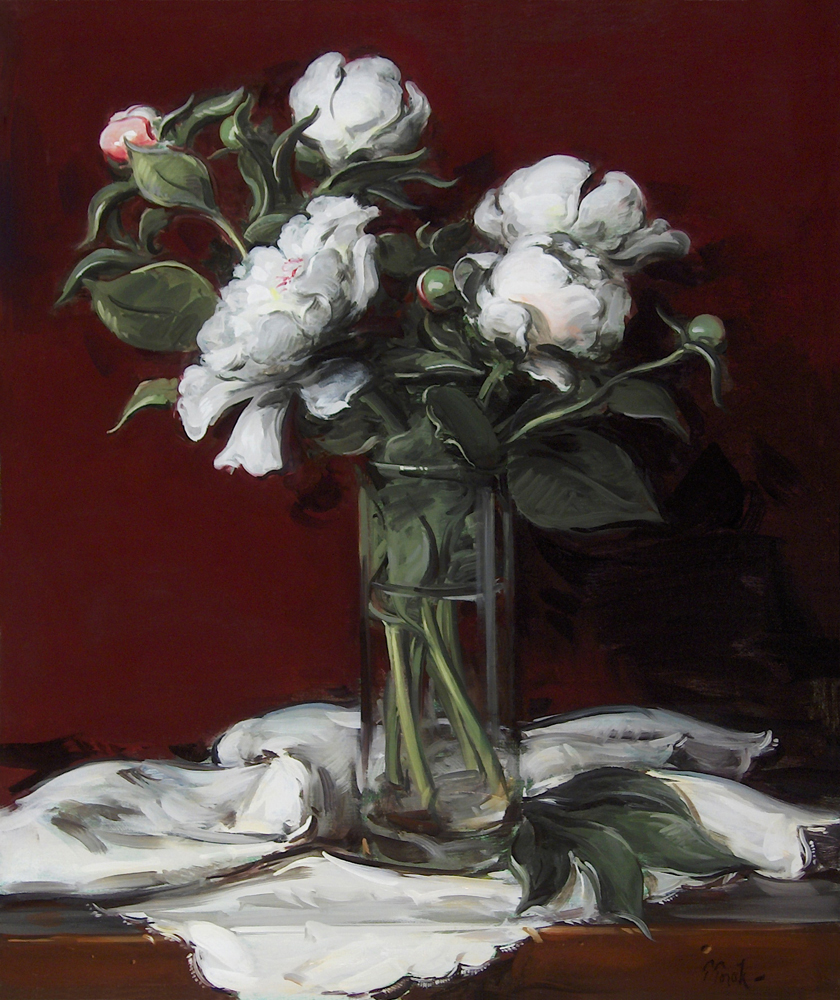
Sometimes, like Appassionata in the previous post, my work is inspired by a specific piece of music. More often, however, I hear what a painting sounds like while I am working on it. Not as a finished piece of music but snippets of rhythm or cadence, harmony or dissonance. In the process of painting these peonies I became aware of what the tempo of the piece should be. Artists usually paint flowers in the early stages of development in a soft, flattering light with little or no shadow to express their innocent, gentle, delicate nature. Flowers in full bloom are often depicted in a more dramatic light or a more colorful setting, using livelier brushwork to set off their magnificent array of petals. I was ready to follow that familiar pattern but as I was cutting these peonies I began to feel that they wanted to be presented in a less dramatic fashion. As I set up the arrangement in my studio I could see that it was rich and full yet I heard it not as an allegro or presto tempo but as a lovely slow movement. The brushwork was lively but not showy, the color was intense but not loud, the mood was calm, tranquil, almost meditative. It had become an adagio for peonies.....

The canvas is an empty space. It is the task of the artist to fill that void with light and form and atmosphere, with wisdom and challenge, with thunderous noise and breathtaking silence, with the glory of heaven and the horrors of hell, and with all the infinite variety and nuance of the human condition. The goal is to create works of art that are able to reach out of the canvas and touch the viewer, to move them in a profound way.....

 Our artistic instincts are developed from a very young age. Not long after we are able to control our fingers a crayon is inserted in our little fists and a piece of paper is placed in front of us. We are encouraged to make whatever marks we like and thus commit our first creative act. A broad smile comes across our face as we see the color recorded on the paper and the joy of creativity becomes a part of us. Mommy's applause let's us know that this joyful act has society's approval. After many happy efforts we budding artist have a desire to advance our drawings. Those joyful scribbles soon become harsher and angrier as frustration sets in. Then mommy demonstrates how to make a circle for a head and dots for eyes and the ever fascinating stick figure. Joy returns as the creative juices are set free. With time we learn to draw everything that is around us, house and family, grass and trees, even sun and rain. Then our imagination kicks in and we create fantastic drawings of monsters and dragons, princesses and pirates. We are well on our way to becoming artists, free and uninhibited, joyful and enchanted. At some point in this process some well meaning person notices our pleasure at creativity and offers us a coloring book. We use our well practiced scribbling technique to fill the page with color, blue hair, green faces, purple hands and sleeves, red, yellow and orange for the dress, shoes and legs and background. The lines of the preprinted drawings are often treated as mere suggestions of boundaries. We are then taught to keep our color within the lines and our artistic freedom meets its first test. Some of us agree and learn to control our color while others reject this attempt to inhibit their creativity. Our artistic philosophy begins to take shape. For those of us who continue to explore this avenue of creativity the coloring book experience is repeated over and over again. We are told that if we adopt this or that technique, or manipulate our pencils or brushes this or that way it will produce this or that effect. We are told that if we do this our work will be considered tasteful and if we do that it will be distasteful. As we accept or reject each suggestion, each lesson, we form our artistic philosophy. No two artists will make the same decisions, and the more we learn, the more we accept or reject, the more unique we become. Every time an artists puts a pencil to paper, or a brush to canvas, he must decide if he will paint within the lines or ignore the boundaries.....

We made sure we had packed everything, clothes, gifts, cookies, food for the road. Then we settled in for the trip to New Jersey and Pennsylvania to see our families for Christmas. We hadn't gone far before I decided to turn back. There was a light snow falling, I thought it was going to be a beautiful drive. But the car slipped and slid, even though we were going straight and only 20 mph. It would take many extra hours at that pace, if we made it at all without sliding off the road. So we returned home feeling glum and a bit defeated. But now Elizabeth is happily reading a book by the fireplace and I will soon join her to read a few more chapters of the out-of-print biography of Sargent that I recently downloaded from the internet. Nature has intervened to slow down the hectic pace of our lives, giving us time to leisurely watch the falling snow, feel the warmth of the glowing fire, and spend a quiet evening together. Perhaps there really are Christmas miracles. We will repack the car and head out again tomorrow to visit our families but tonight is ours. Merry Christmas my love.....


Normally when I step outside to study the night it takes a little while for my eyes to adjust to the change of light, but not on this night. The moon was low and full and big. It illuminated the sky and bounced off the new snow. My shadow suggested it might not be nighttime yet. I began to wonder if it would be cheating to call this a nocturne. I waited and watched as the moon ascended. It had only been an hour or so since the snow had stopped falling. The clouds were gone but there was still a lot of moisture in the air. The thickness of the atmosphere beneath the celestial dome gave the sky a lovely violet hue. I could feel the cool moisture all around me and began to consider the possibility that I might see a moonbow. After a while the moon was far enough away from the earth and the reflection from the ground sufficiently subdued, that I felt confident when I painted the scene it would indeed be a nocturne. Still, when I went to bed that night there was so much light coming in the window I got up to make sure I hadn't left the porch light on....
 In the two previous posts we discussed painting physical and psychological portraits of our subject matter and of the light falling on it. Now we must consider a third portrait, the space that our subject occupies. As a simple example of how space affects a painting let's consider a couple of well known masterpieces. Imagine the Mona Lisa without a landscape behind her. If she were portrayed with the same pose and clothing, the same enigmatic smile, but in front of a blank wall, how different the painting would be. Or perhaps Whistler's Mother seen rocking, not in her gray room, but on her front porch or in her garden. Only the space would be different but now we would have a new picture of her. Let's go back to studio 7 at the League where the classroom portrait shown here was painted. There is space between the portrait and the background, in this case a very shallow space. We can't see or feel the space yet we know it exists and we must paint it. If we fail to paint that space our figure will look as if she were glued to the wall. The quality, a portrait, of the space must be expressed, if it is dry or misty, shallow or vast, crisp or gloomy. Now our painting has an excellent chance to succeed, we are painting everything we see, physical and psychological portraits of our subject, the light that falls on that subject and the space it occupies.....
 In the previous post we painted a physical and psychological portrait of a female figure. When we paint a landscape or still life we do the same thing; capture a likeness and the character of the trees or fields, or mountains or clouds, or apples or flowers before us. We also want to paint a portrait of the light that illuminates our subject. The figure shown here is a classroom critique that I gave in studio 7 at the Art Students League. Studio 7 has a marvelous skylight so our figure is lit by natural light. Now imagine that you are in the night class in the same studio. You are painting in the same spot, with the same model in the same pose, but with artificial light. The only difference is the character of the light falling on your figure, yet you will have a very different painting. Any plein air landscape painter can tell how frustrating it is when you are doing a sunny painting and the sun moves in and out of the clouds. Each time the sun appears or disappears your painting changes. The light has changed, it has a different character. Now we've become aware that what attracted us to the subject of our painting was not only the scene or the object but also the way it was lit and the quality of that light. So we must paint an expressive portrait of the light. We are now painting two portraits, one of the subject and one of the light, but there is yet one more portrait to consider for our masterpiece.....


I often paint what I hear in addition to what I see. When I was painting Muffins I heard a rather whimsical woodwind quartet in the style of Prokofiev. I heard the oboe gently dropping chocolate chips into the dough, a playful flute signified the muffins rising in the oven. A bluesy clarinet played the muffins cooling on a rack while a witty bassoon indicated a dollop of jelly being spread on the half eaten muffin. I've never actually heard a woodwind quartet by Prokofiev or even know if he ever wrote one. But if he did, and someday a musicologist finds it in some dusty archive, I'm sure there will be a notation calling it the Muffin Quartet.....
The Painting of the Month is a special offer to my blog readers (click on the image for a larger view). This month Muffins, which retails for $2200, is being made available for $1200 (includes shipping, VT residents add 6% sales tax). To purchase this piece contact me at thomastorak@gmail.com. Payment is by check only please, no credit cards. If you prefer you may make 3 monthly payments. This offer is available for 30 days from the date of this post.

At midnight on a moonless, cloudless night, I turn off all the lights in my house and use a flashlight to guide my way to the middle of an empty field. Then I turn off the flashlight, lie on my back and stare straight up at the sky. I am alone, there is no evidence of human existence. As my eyes adjust to the darkness I become vaguely aware of a distant hillside and an arboreal phantom in the blue-black void. But I am drawn like a magnet to the heavens. I reach out my hand and feel like a giant next to the tiny stars. Then watch the distant stars getting smaller and dimmer as they recede into the vastness of space, and suddenly feel very small. The twinkling stars make the heavens seem like a lovely, sensitive living thing, and it's strangely comforting to lie here alone in what feels like the womb of the universe. I contemplate the infinite possibilities of time and space, and dream about my next life, when this fetal existence ends....

The moon was a bit tardy tonight. It was nearly full last night and was expected to be the star of show this evening. I was sure it would have made its entrance by now. Perhaps it had a quarrel with one of the constellations last night and was refusing to go on. Was Orion the hunter a bit too aggressive, or Cassiopeia the queen making unreasonable demands? In the midst of my silly musing a glow began to appear in the night sky. Before long the moon made a dramatic entrance, choosing to appear behind the branches of my favorite apple tree. The glow was so bright it obscured the edges of the lunar disc. Rising slowly it highlighted one branch then another. Some of the branches made gnarly silhouettes while others reached out to catch a moonbeam. There was the excitement of anticipation in the air. It was a grand entrance indeed and I couldn't wait to see it join the stars for tonight's celestial performance.....

In rural

I often ask my students to tell me their thoughts about the piece they are working on. Not that I don't have my own thoughts, but it clues me in to how they are thinking as they create their paintings. Recently one of my best students, who was working on a nude, said he wasn't sure if he had gotten the leg right. Yes, I replied, it looks a bit dull and lifeless. Well, he said, I saw more light there but I didn't want it to compete with the big light on the torso. There's your answer I replied, you've taken a negative approach. You painted the leg so that it would not be something. Wouldn't it be better to paint the leg so that it expresses what you want it to say rather than what you don't want it to do? Let it live, let it take its rightful place in the painting. If nature has blessed it with light then express that with joy and confidence. It is always better to approach your painting, or any part of your painting, with a positive attitude, "this is what I want to have happen here", rather than negatively, "I don't want this to happen here". When you paint a negative thought you tell the viewer "don't look at this". When you paint the leg in its full glory you say to the viewer "come, celebrate with with me, for we are sharing something amazing".....

I love when composers write variations on a theme and when musicians improvise. West Pawlet Farm, in the previous post, was painted on location. It is a lovely interpretation of what was happening at that place on that day. A romantic painting of rural charm, round bales of hay drying in the open air before being brought to the barn to be stored for winter feeding. As I looked at the painting in my studio I began to hear variations, passages being expressed in different ways. I pulled out a panel, a square panel, a more daring shape than the original, and began to improvise. The horizon moved up in the composition to create a more dramatic view up the hill to the farm. The weather became full sunlight to make the hay bales dry faster. I decided to make the clouds big and thick, moving swiftly through the sky. Still romantic but lighter and faster. I hear West Pawlet Farm as an adagio movement, Round Bales as an allegro tempo. I could hear other variations, a thunderstorm perhaps, presto, furiouso, or a largo with a rainbow. The elements are the same but with a different character. Perhaps in another variation the hay bales would be gone and cows would be grazing in the field. The possibilities are endless. I can see an entire exhibit of paintings of the same scene, variations created in my studio, inspired by a single afternoon painting en plein air.....

Indoor painting is for introverts, outdoor painting is for extroverts. You are alone with your thoughts when painting indoors, outside you share your thoughts with birds and cows or anyone passing by. Indoors you usually know what you will be painting before you enter the studio, outdoors you never know what you will paint until you come upon an exciting scene. Indoors everything is under control, the light is consistent, the temperature just right, anything you might need is nearby. Outdoors you go with the flow, a storm can blow through or a rainbow appear, something is always happening. Indoors you can work on the same painting for many hours or many days, outdoors you can finish several paintings in a single day. Indoors you meditate, outdoors you engage. Indoors it is quiet, perhaps too quiet, let me just check my email. Outdoors it is wild, exciting, perhaps too wild, why is that hawk staring at me.....

I had the most delightfully lovely day today. Elizabeth and I rose late and decided to have breakfast out. There is a marvelous cheesemaker nearby with an unspeakably charming goat farm. On the weekends they have a cafe where one can have various baked goods or a goat cheese panini with fresh coffee or a pot of tea. It isn't meant to be a money making enterprise, just a pleasant environment for friends to gather and chat and, often, make new friends. We arrived this morning to find our friend Tim (who you may remember from an earlier post) playing his recorder with two other recorder players and accompanying a lovely singer. Each of the recorder players had several recorders with them and took turns playing the alto, soprano and bass parts. They played mostly renaissance music, the singer showing a talent for interpreting the works of John Dowland. This was not about money either, they were playing for free for anyone who cared to listen. It was a gloriously sunny morning, we sat outside with our refreshments, listening to sweet music, watching the nearby kid goats frolic, visiting with old friends and new. After a few hours we started home, we had promised our dog that we would take her for a hike in the woods in the afternoon. As we drove home through a breathtakingly beautiful landscape I was reminded of how much I love the life I have. Well, there isn't anything about painting in this post, but it's my 144th post so I'm taking a bit of a break. Besides, if you don't get out and enjoy life you probably won't have much to say with your paintings.....
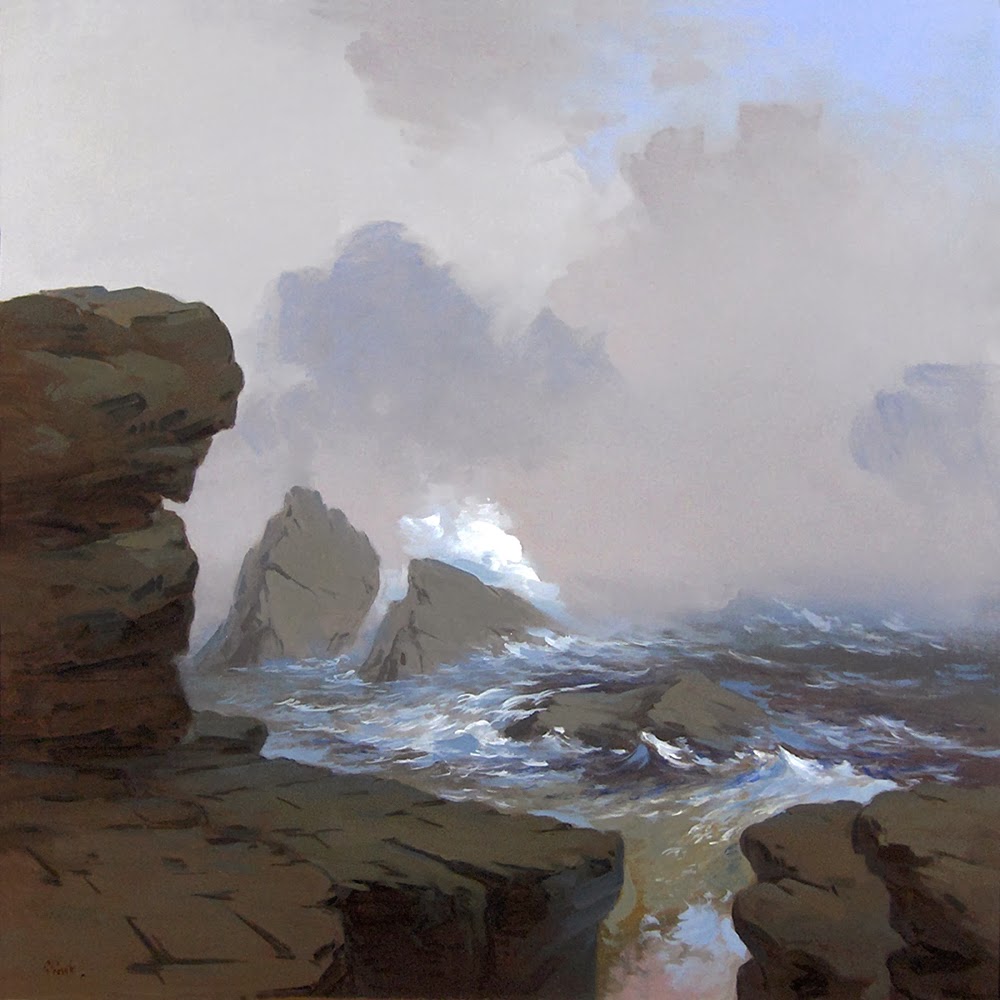
 Atlantic Surf
The new League catalog just came out with the schedule for the summer and fall classes. If it had a hard cover it would make a wonderful fine art book. Each instructor is given a full page with a beautiful reproduction of their work, some biographical information and a description of the class. In the back are examples of a student's work from each class. Near the front of the catalog is a page with the header Leading artists talk about the League. There are quotes from Peter Max, Everett Raymond Kinstler, Mark Rothko and others. My favorite is from Georgia O'Keeffe talking about her experience in William Merritt Chase's class. "Chase", she says,"encouraged individuality and gave a sense of style and freedom to his students...There was something fresh and energetic and fierce and exciting about him...To interest him, the paintings had to be alive with paint." I may not be as fresh or energetic or fierce or exciting as Chase but I express that same philosophy to my students, the painting has to be alive.....
 Peppers
When an artist sees something beautiful he must paint it. In order to give it form he must also paint the space behind it. He then realizes that there is space in front of the object and that he is standing in that space. Now he is aware that he is in a room and that room is in a building. The building occupies space in a city and the city is but a small part of the world. It soon becomes obvious that in order to paint his beautiful object in its full glory he must bring to it all the expression and wisdom and experience of the entire universe.....
