
Winter, Gibbous Moon
16 x 16 Oil on Panel


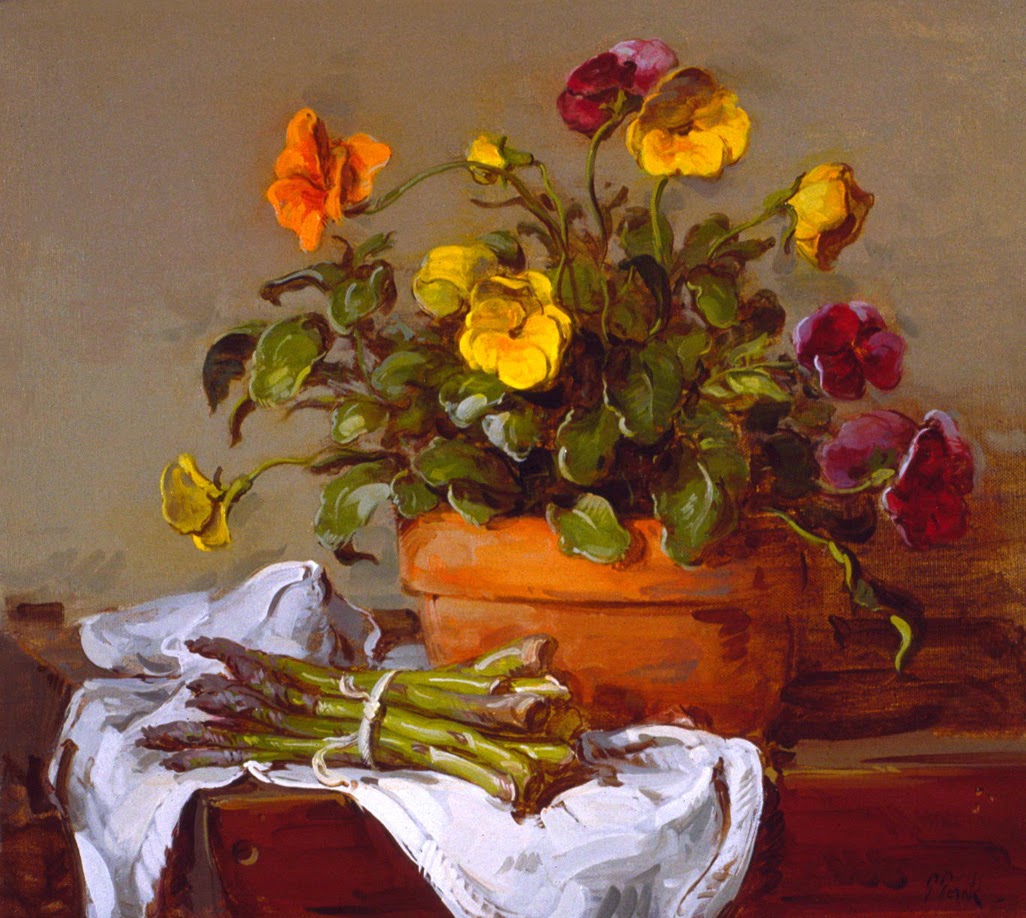


I was lying awake in bed last night thinking about how to teach my students to create atmosphere in a painting. Painting something you can't see is much more difficult than painting the observed physical forms in front of you. Perhaps if I presented it as painting a concept, as opposed to an object, I might be able to break through. I went to the computer to see what I could find about conceptual art, hoping to find something useful for my lesson. The definition of conceptual art is a rather free floating concept itself but basically any work of art where the original idea, the concept, is more important than the actual work qualifies. Then I went to my website and reread my artist's statement, I use still lifes and landscapes and figures to explore the possibilities of light and space and mystery in a painting it said. I clicked on the image of my Bread and Eggs painting which is not at all about bread and eggs and fruit but rather is about luminosity and atmosphere, design and color. That sounds like conceptual art to me I thought so I went to see the exhibit at the Tate, a comprehensive history of conceptual art starting with what they call preconceptual art, Turner's late seascapes and Whistler's arrangements and symphonies, and then moves on to classic conceptual pieces like Duchamp's urinal/fountain, and there are installations of course, one with a room full of people seated quietly in the middle of the room examining their reactions as lights of varying color and intensity and duration flashed around them, and another where everyone walked through a collection of objects from the life of the artist, again in silence, installations almost always require silence, and observed their feelings about those objects and then discussed those feelings in front of a video camera as they emerged on the far side of the room, thus participating in and becoming a part of the work, then postconceptual work like Damian Hirst's bisected and dissected animals in formaldehyde and Tracy Emin's bed and the last room labeled neo-postconceptual art is filled with my paintings and there is Damian Hirst standing in front of my Bread and Eggs saying "I don't get this stuff", paintings do not require silence, and Tracy Emin bent over reading the curator's text on the wall trying to find out why this is important since has nothing to do with her life or who she has slept with and then I hear music, a Beethoven string quartet, one of his Razumovsky quartets, and I think what an interesting choice of music for this exhibit, then realize it is my alarm clock, set on the radio mode. I got up and showered and headed out to catch the train to the NY, to try to explain to my students how to create atmosphere in a painting.....


Picasso
is alleged to have said "bad artists borrow, good artists steal." If
that is true then I'm a good artist. Elizabeth and I once took a two week trip
to

When I go to museums I generally find myself spending less time with the well known masterpieces, preferring instead to seek out the small studies and historically less significant pieces. These are often the ones created with the most artistic freedom. Commissioned works are very important to the survival of the artist but are always to some degree a collaboration of the artist and his patron. I like to see what an artist does when he is unfettered. Studies for large works are usually not expected to be seen, or exhibited, or purchased so the artist abandons any attempt at a pretty finish and instead allows the work to be pure expression. When these pieces do survive and are exhibited they are as close as you can come to having a conversation with the artist about his philosophy of art. The other works I like to spend time with are pieces that the artist does for his own amusement. Artistic caprices. Like musical capriccios they are generally upbeat, lively pieces. No great meaning or message, no adherence to rules or dogma, perhaps not even very interesting subject matter, just pure joy in being alive and being an artist.....

Artists
are liars. Botticelli was a liar. So was Renoir. Poussin, El Greco, Corregio,
Gainsborough and Eakins were liars. The little Dutchmen, the

In the
early '90s, when we were still living in

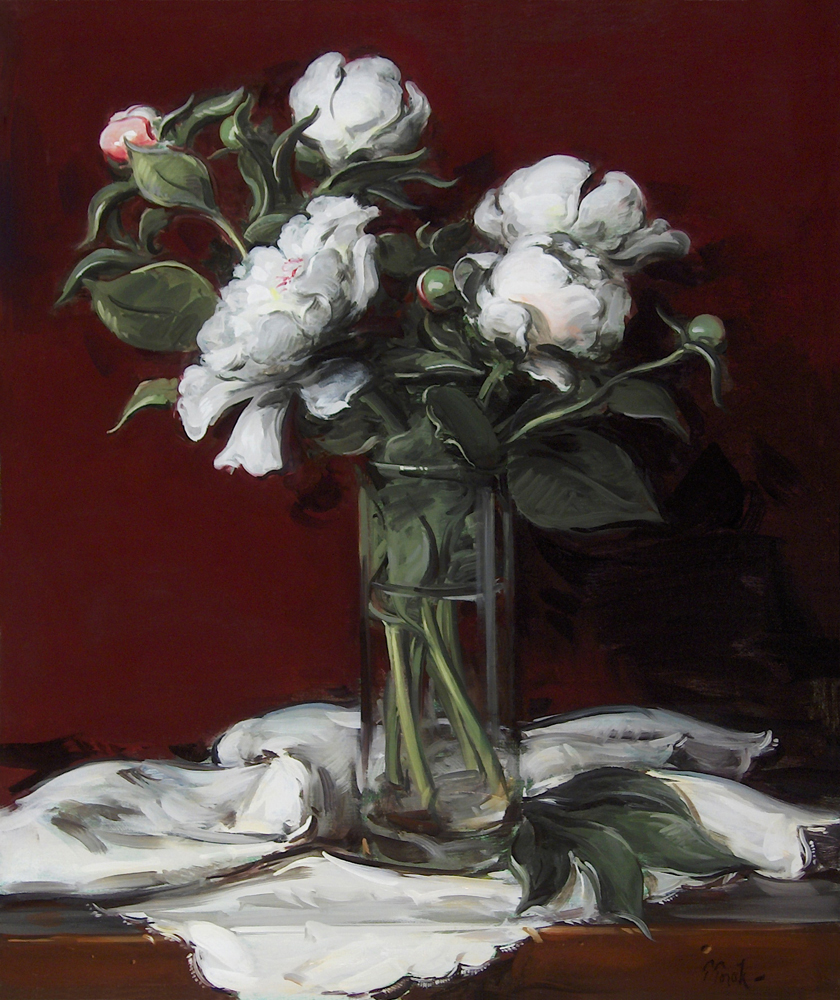
Sometimes, like Appassionata in the previous post, my work is inspired by a specific piece of music. More often, however, I hear what a painting sounds like while I am working on it. Not as a finished piece of music but snippets of rhythm or cadence, harmony or dissonance. In the process of painting these peonies I became aware of what the tempo of the piece should be. Artists usually paint flowers in the early stages of development in a soft, flattering light with little or no shadow to express their innocent, gentle, delicate nature. Flowers in full bloom are often depicted in a more dramatic light or a more colorful setting, using livelier brushwork to set off their magnificent array of petals. I was ready to follow that familiar pattern but as I was cutting these peonies I began to feel that they wanted to be presented in a less dramatic fashion. As I set up the arrangement in my studio I could see that it was rich and full yet I heard it not as an allegro or presto tempo but as a lovely slow movement. The brushwork was lively but not showy, the color was intense but not loud, the mood was calm, tranquil, almost meditative. It had become an adagio for peonies.....

The canvas is an empty space. It is the task of the artist to fill that void with light and form and atmosphere, with wisdom and challenge, with thunderous noise and breathtaking silence, with the glory of heaven and the horrors of hell, and with all the infinite variety and nuance of the human condition. The goal is to create works of art that are able to reach out of the canvas and touch the viewer, to move them in a profound way.....

 Our artistic instincts are developed from a very young age. Not long after we are able to control our fingers a crayon is inserted in our little fists and a piece of paper is placed in front of us. We are encouraged to make whatever marks we like and thus commit our first creative act. A broad smile comes across our face as we see the color recorded on the paper and the joy of creativity becomes a part of us. Mommy's applause let's us know that this joyful act has society's approval. After many happy efforts we budding artist have a desire to advance our drawings. Those joyful scribbles soon become harsher and angrier as frustration sets in. Then mommy demonstrates how to make a circle for a head and dots for eyes and the ever fascinating stick figure. Joy returns as the creative juices are set free. With time we learn to draw everything that is around us, house and family, grass and trees, even sun and rain. Then our imagination kicks in and we create fantastic drawings of monsters and dragons, princesses and pirates. We are well on our way to becoming artists, free and uninhibited, joyful and enchanted. At some point in this process some well meaning person notices our pleasure at creativity and offers us a coloring book. We use our well practiced scribbling technique to fill the page with color, blue hair, green faces, purple hands and sleeves, red, yellow and orange for the dress, shoes and legs and background. The lines of the preprinted drawings are often treated as mere suggestions of boundaries. We are then taught to keep our color within the lines and our artistic freedom meets its first test. Some of us agree and learn to control our color while others reject this attempt to inhibit their creativity. Our artistic philosophy begins to take shape. For those of us who continue to explore this avenue of creativity the coloring book experience is repeated over and over again. We are told that if we adopt this or that technique, or manipulate our pencils or brushes this or that way it will produce this or that effect. We are told that if we do this our work will be considered tasteful and if we do that it will be distasteful. As we accept or reject each suggestion, each lesson, we form our artistic philosophy. No two artists will make the same decisions, and the more we learn, the more we accept or reject, the more unique we become. Every time an artists puts a pencil to paper, or a brush to canvas, he must decide if he will paint within the lines or ignore the boundaries.....

We made sure we had packed everything, clothes, gifts, cookies, food for the road. Then we settled in for the trip to New Jersey and Pennsylvania to see our families for Christmas. We hadn't gone far before I decided to turn back. There was a light snow falling, I thought it was going to be a beautiful drive. But the car slipped and slid, even though we were going straight and only 20 mph. It would take many extra hours at that pace, if we made it at all without sliding off the road. So we returned home feeling glum and a bit defeated. But now Elizabeth is happily reading a book by the fireplace and I will soon join her to read a few more chapters of the out-of-print biography of Sargent that I recently downloaded from the internet. Nature has intervened to slow down the hectic pace of our lives, giving us time to leisurely watch the falling snow, feel the warmth of the glowing fire, and spend a quiet evening together. Perhaps there really are Christmas miracles. We will repack the car and head out again tomorrow to visit our families but tonight is ours. Merry Christmas my love.....


Normally when I step outside to study the night it takes a little while for my eyes to adjust to the change of light, but not on this night. The moon was low and full and big. It illuminated the sky and bounced off the new snow. My shadow suggested it might not be nighttime yet. I began to wonder if it would be cheating to call this a nocturne. I waited and watched as the moon ascended. It had only been an hour or so since the snow had stopped falling. The clouds were gone but there was still a lot of moisture in the air. The thickness of the atmosphere beneath the celestial dome gave the sky a lovely violet hue. I could feel the cool moisture all around me and began to consider the possibility that I might see a moonbow. After a while the moon was far enough away from the earth and the reflection from the ground sufficiently subdued, that I felt confident when I painted the scene it would indeed be a nocturne. Still, when I went to bed that night there was so much light coming in the window I got up to make sure I hadn't left the porch light on....
 In the two previous posts we discussed painting physical and psychological portraits of our subject matter and of the light falling on it. Now we must consider a third portrait, the space that our subject occupies. As a simple example of how space affects a painting let's consider a couple of well known masterpieces. Imagine the Mona Lisa without a landscape behind her. If she were portrayed with the same pose and clothing, the same enigmatic smile, but in front of a blank wall, how different the painting would be. Or perhaps Whistler's Mother seen rocking, not in her gray room, but on her front porch or in her garden. Only the space would be different but now we would have a new picture of her. Let's go back to studio 7 at the League where the classroom portrait shown here was painted. There is space between the portrait and the background, in this case a very shallow space. We can't see or feel the space yet we know it exists and we must paint it. If we fail to paint that space our figure will look as if she were glued to the wall. The quality, a portrait, of the space must be expressed, if it is dry or misty, shallow or vast, crisp or gloomy. Now our painting has an excellent chance to succeed, we are painting everything we see, physical and psychological portraits of our subject, the light that falls on that subject and the space it occupies.....
 In the previous post we painted a physical and psychological portrait of a female figure. When we paint a landscape or still life we do the same thing; capture a likeness and the character of the trees or fields, or mountains or clouds, or apples or flowers before us. We also want to paint a portrait of the light that illuminates our subject. The figure shown here is a classroom critique that I gave in studio 7 at the Art Students League. Studio 7 has a marvelous skylight so our figure is lit by natural light. Now imagine that you are in the night class in the same studio. You are painting in the same spot, with the same model in the same pose, but with artificial light. The only difference is the character of the light falling on your figure, yet you will have a very different painting. Any plein air landscape painter can tell how frustrating it is when you are doing a sunny painting and the sun moves in and out of the clouds. Each time the sun appears or disappears your painting changes. The light has changed, it has a different character. Now we've become aware that what attracted us to the subject of our painting was not only the scene or the object but also the way it was lit and the quality of that light. So we must paint an expressive portrait of the light. We are now painting two portraits, one of the subject and one of the light, but there is yet one more portrait to consider for our masterpiece.....

