Monday, January 17, 2011

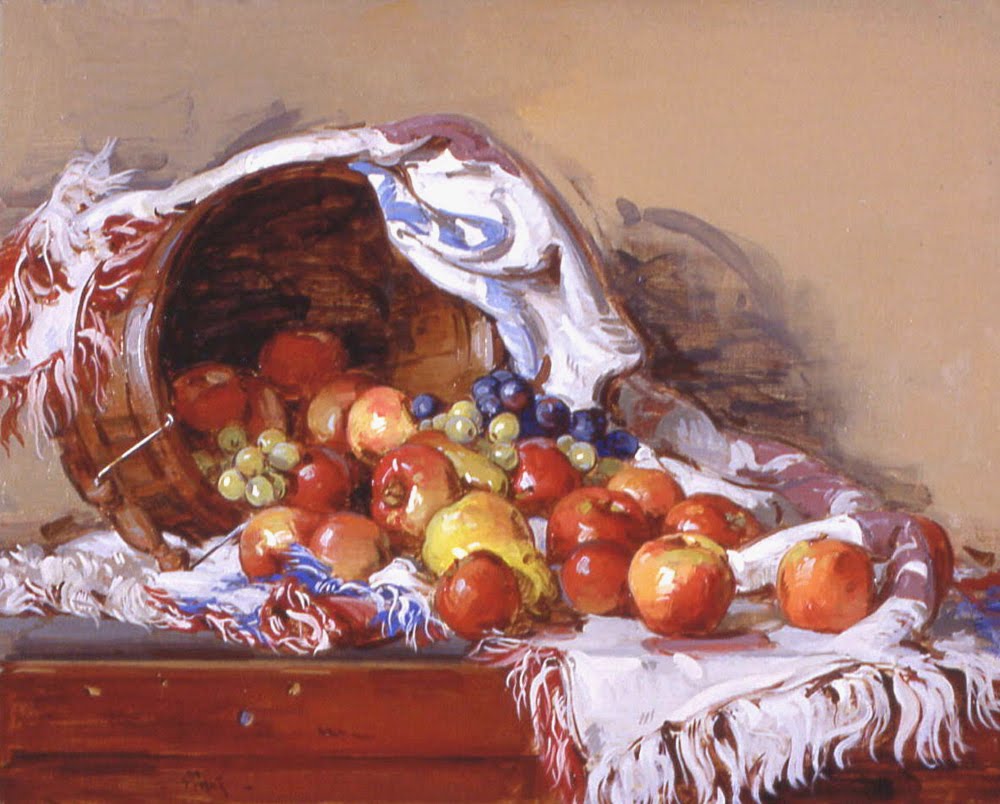
Mostly Apples
24 x 30 Oil on Linen

I read a lot about art and artists when I was a sudent. One of my favorite stories was about a, perhaps apocryphal, meeting between Van Dyck and Hals. As Van Dyck was on his way to England to paint for King Charles he stopped by the studio of Frans Hals. Without introducing himself he said "I have a little time before my boat leaves, would you paint my portrait?" "But of course" Hals replied. He grabbed the nearest canvas and set to work. Forty-five minutes later he showed the sitter his lively masterpiece. "Excellent" the unknown man remarked. "You looked like you were having quite a good time as you worked. Would you mind sitting for me? I'd like to give it a try." Hals, always ready for an adventure, agreed. Forty-five minutes later, painting as quickly as Hals himself, the mysterious stranger's picture was finished. Hals walked around the easel and found a magnificent portrait. Astonished, he gave the man a quizzical look. "You're either Van Dyck" said Hals solving the riddle, "or you're the devil".....

Saturday, January 8, 2011

PAINTING OF THE MONTH

Rhapsody in Green
Oil on Linen
Image 18 x 24 - Framed 25 x 31
$1500

My intention was to set up a beautiful little classical still life. I was hoping to hear a piano concerto by Mozart or Schubert or Brahms but instead the opening clarinet glissando from Gershwin's Rhapsody in Blue poured into my head. I decided to go with it and see what would happen. Like Gershwin I stayed with a classical structure but moved away from the concerto arrangement to the more free flowing rhapsody form. He used jazz themes to make his piece livelier, I brought in a wicker basket to make my arrangement less formal. The fruit gravitated to the basket making it the lead instrument. The still life came together quickly, spontaneously, and I painted without restraint, as if I were improvising on the canvas. Classical, but informal, rich and lively, thanks for the inspiration George.....


The Painting of the Month is a special offer to my blog readers (click on the image for a larger view). This month Rhapsody in Green, which retails for $3200, is being made available for $1500 (includes shipping, VT residents add 6% sales tax). To purchase this piece contact me at thomastorak@gmail.com. Payment is by check only please, no credit cards. If you prefer you may make 3 monthly payments. This offer is available for 30 days from the date of this post.

Friday, December 31, 2010

Women in Art II: Preparing to Paint
30 x 40 Oil on Linen

Artists who painted illuminated manuscripts expressed their love of God. In the Renaissance artists painted for the church, after that for wealthy patrons. Early nineteenth century paintings glorified nature. Late nineteenth century paintings celebrated art for art's sake. The twentieth century focused on the deconstruction and finally the death of painting. The current art of the image is video. End of story. Well not quite. The rise of photography was expected to put an end to painting too. But painting coexists peacefully with photography, as it will with video and digital imaging and whatever else comes next. The question is not will painting survive, but what will the artists paint, and for whom, and what will they have a burning desire to express and glorify and celebrate in the 21st and 22nd and 23rd centuries.....

Sunday, December 12, 2010

White Roses
20 x 16 Oil on Linen

Edges. Artists, especially art students, think and talk a lot about edges. With great intensity they discuss the merits of soft edges and hard edges, warm and cool edges, edges between positive and negative spaces. They become very important as a compositional elements, directing the viewer over the surface of the painting as if guiding them through a maze. I don’t mind a good edge from time to time but I don’t see as many edges as most artists. In my paintings edges exist only where two planes meet. The top of a table meeting the front, for example, or the where the two side planes of a book meet. In White Roses the only edge is where the cloth lays flat on the tabletop and then drops over the front plane. There are no edges to the flowers or the vase, the leaves, stems or drapery. There is no edge to a rounded form. A rose has no edge. Many artists see an edge where the rose meets the background. The form, as I see it, turns away from the viewer but has no edge. It does not meet the background, there is space between the two. There is a change of color, value and texture where the eye loses the flower and picks up the background but it is not an edge. An edge would exist only if the flower were pressed against the background. The glass vase also turns and has no edge. Where the vertical plane of the vase meets the horizontal plane of the tabletop there would be an edge but that is hidden by the drapery. You might argue that my definition of an edge is a bit too literal, but I would say that it is not literal but liberating. By limiting my edges to true edges I allow my painting to express a greater variety of forms, more space, breadth and atmosphere.....

Tuesday, November 30, 2010

Portrait of I.I. Rabi
36 x 30 Oil on Linen

Shortly after we were married Elizabeth's grandfather asked me to paint his portrait. I. I. Rabi was a champion of science, a great physicist, chair of Columbia University's physics department and an advisor to presidents. He was awarded a Nobel Prize for his work on nuclear magnetic resonance. Rabi had a beautiful mind and we had marvelous conversations as he sat for me. There were two moments that have stayed with me and helped shape my artistic philosophy. One came as we were discussing beauty, not only in art but also in mathematics, philosophy and science. When he was solving a problem, he said, it was not good enough to simply come up with a correct answer. The problem was not resolved until it had an elegant solution. The second came as we talked about teaching. His students would often approach him with ideas for a doctoral thesis and ask if it was an appropriate subject. He would answer with a question of his own, "Does it bring you closer to God?"*.....

*I don't want to misrepresent Professor Rabi here, he was not a particularly religious man. Unlocking the mysteries of the universe was his way of being closer to God. No matter how you define God, Rabi's remark is a profoundly beautiful way to approach one's endeavors.

Wednesday, November 10, 2010

PAINTING OF THE MONTH

Autumn Poem
Oil on Linen
Image 30 x 24 - Framed 39 x 33
$3000

Felix Mendelssohn wrote eight volumes of Songs without Words. Composed at various points throughout his life, each volume consists of a series of six short lyrical pieces for the piano. A few of the songs have acquired titles, The Spinner's Song or The Morning Song, but they have essentially survived as songs without words as Mendelssohn intended. With that in mind I composed my Autumn Poem. Perhaps I'll paint more poems throughout my life and one day there may be an exhibition of my Poems without Words.....

The Painting of the Month is a special offer to my blog readers (click on the image for a larger view). This month Autumn Poem, which retails for $5200, is being made available for $3000 (includes shipping, VT residents add 6% sales tax). To purchase this piece contact me at thomastorak@gmail.com. Payment is by check only please, no credit cards. If you prefer you may make 3 monthly payments. This offer is available for 30 days from the date of this post.

Wednesday, November 3, 2010

Hubbard Squash and Onions
34 x 40 Oil on Linen

While delivering paintings to a show over the weekend I heard an interview with Michael Caine on the radio. He was talking about his early acting experiences. Once he had a small part playing a drunken man. He staggered onto the stage and slurred his lines. No, no, no the director shouted, you are only imitating what a drunk looks like. In order to act like a drunk you must think like one, someone who is drunk is trying very hard to walk straight and talk normally. It was an important lesson, one he never forgot. It reminded me of what happens so often in painting. Many artists get so caught up in the tones and edges they see that they merely imitate what is in front of them. They are outside of the painting looking at the subject as if it were an animal on exhibit in a zoo. The artist should be more like the actor who inhabits his character. Instead of standing outside his work he must become one with the subject of the painting. The artist is the voice for the sitter. He should be able to tell the viewer what his subject thinks and why it looks the way it does. Then there can be communication between the viewer and the painting: a conversation with the portrait, a desire to walk in the landscape, to smell the flowers and touch the fruit. Not simply because it looks real but because it is saying something, there is something interesting about the painting that we want to explore, to know and absorb to enrich our life.....

Wednesday, October 27, 2010

Autumn Trees
10 x 12 Oil on Panel

These are hard economic times. Many people are having a hard time coming up with money to pay for food and housing. Buying a painting is way down on their list of priorities. Galleries are closing their doors. Artists are having a harder and harder time selling paintings. “Don't give up hope” my teacher once said to me “so long as there are two people left on the face of the Earth one is going to want the other to paint his portrait”.....

Saturday, October 9, 2010

The Dutch Bowl
36 x 30 Oil on Linen


Painting has completely taken over my life. Everywhere I look I see shapes and forms, patterns, rhythms, compositions. I no longer use language to communicate. I speak in pigments and taste color. I hear sounds as gradations from black to white, voices have warm or cool tones. I smell opacities and transparencies and analyze the structure and weight, volume and texture of everything I touch. Each breath is a brushstroke. Sometimes I think if I cut my finger I would bleed linseed oil.....

Tuesday, September 21, 2010

PAINTING OF THE MONTH

The Morning Newspaper
Oil on Linen
Image 16 x 24 - Framed 23 x 31
$2100

Is the world we are painting now so different than the one the Old Masters were painting? The light that falls on us today is the same light that lit a Rembrandt portrait. When that light is blocked we experience the same mysterious shadows that Caravaggio painted. The air we breathe and the space we occupy is the same space that Frans Hals' Laughing Cavalier inhabited. The wind that blows through our landscape is the same breeze that animated Corot's trees and our stars also appeared in Van Gogh's Starry Night. Yes there have been advances in science and technology, and we now read the morning newspaper and sip coffee made in a drip coffee maker, but is it really so different?.....

The Painting of the Month is a special offer to my blog readers (click on the image for a larger view). This month The Morning Newspaper, which retails for $3600, is being made available for $2100 (includes shipping, VT residents add 6% sales tax). To purchase this piece contact me at thomastorak@gmail.com. Payment is by check only please, no credit cards. If you prefer you may make 3 monthly payments. This offer is available for 30 days from the date of this post.

Wednesday, September 1, 2010

Upholding the Classical Tradition
24 x 36 Oil on Linen

Artistic experiences: part 6, Mason’s class
I soon found out I wasn’t the only League student working at Carnegie Hall. Several of the ushers were artists too and we became fast friends. After the evening’s concert was over 4 or 5 of us would go across the street to Carney’s bar and talk for hours over a few pitchers of beer. They had been in New York longer than me and I was anxious to hear what they had to say. The conversation was not just about painting, although there was plenty of that, but also about music and philosophy, politics and history. These were not a bunch of dopey social misfits, as artists sometimes are, they were highly intelligent, well educated and fascinating. I was impressed by their conversation and, even though I had yet to see their work, wanted to know who they were studying with. They all had the same answer, Frank Mason. I knew Mason’s work from an article in American Artist magazine and his full length standing portrait in the League’s Instructors Exhibition was my favorite in the show. They introduced me to their mentor and I signed up for his class without hesitation. My first critique was a little embarrassing but very profound for me. Mason’s class was so popular that it spilled over into a second room. Because I was starting in the middle of the week I had to find a place to paint wherever I could. Both rooms were packed and there was no place for me to set up where I could see the model so I set up near the doorway, opposite the skylight, and started a painting of a plaster cast of Donatello’s David. Mason showed up the next day, quickly glanced at what I was doing, then said “turn your easel around so you can get more light on your painting and get yourself a hat so you won’t be blinded by the skylight. Now follow me around and watch the other crits, you’ll learn much faster that way.” It only took 10 seconds but it was extremely important to me, I was being taken seriously as an artist…..

Sunday, August 29, 2010

Studio Interior
44 x 54 Oil on Linen

Artistic experiences: part 5, the League
Five days before my 21st birthday I left my old life behind and started my new life. With all my possessions in two large suitcases I boarded a train for New York and checked into the 63rd Street YMCA. I knew I had to find a job and an apartment but the first thing I did was register for a class at the Art Students League. I purchased a big newsprint pad and some vine charcoal, headed up to the second floor, found an empty chair and started to draw. I never felt more alive. As the weeks passed by I found a place to live and got a job working at a concession stand in Carnegie Hall, half a block from the League. I would visit galleries and museums in the morning, draw at the League in the afternoon and listen to the concerts while I worked in the evening. My cultural life was definitely improving. The instructor in my first class was nice enough but more encouraging than instructive. I was hungry to learn and switched to Hale’s anatomy class. Robert Beverly Hale was a legendary anatomy teacher and I drank in as much as I could. I couldn't learn fast enough. I practiced drawing boxes of all sizes and lighting them from different directions. I worked hard on shading forms from light to dark and drawing lines that went around those forms. Soon I found myself reading and copying out of anatomy books at midnight when I got home from work. During the breaks in my drawing class I would wander around the League poking my head into the painting classes. I knew I had to improve my drawing skills but I was eager to paint…..

Thursday, August 26, 2010

Silver and Gold
16 x 18 Oil on Linen

Artistic experiences: part 4, art school.
No one ever told that me that I could make a living as an artist, but then again no one ever told me that I couldn’t. In fact I never discussed it with anyone. After my friends went away to college I got a job in one of the local factories. I decided to try to learn something about painting at night and sent away for the Famous Artists School painting program. I would produce a picture according to the lesson plan and mail it to the school, an artist at the school would correct my picture and mail it back to me. It didn’t take long for me to realize that this was no way to learn how to paint so after 3 lessons I became a mail order art school dropout. It did make me aware of how much I wanted to get started painting. So I did some research and sent away for information from every art school I could find in the country. They were all pretty much the same. There was a prescribed course where you learned drawing, painting, sculpture, printmaking, photography, etc, etc, etc. And they were all expensive. Then I received the catalog from the Art Students League. The work by the instructors was better than at any of the other schools. At the League you pay a small amount per month and choose what classes you want to take. No prescribed course, no papers to write, no grading, no degree program. No portfolio to present for admission, I could just show up and learn to paint. I knew immediately where I was going…..

Tuesday, August 24, 2010

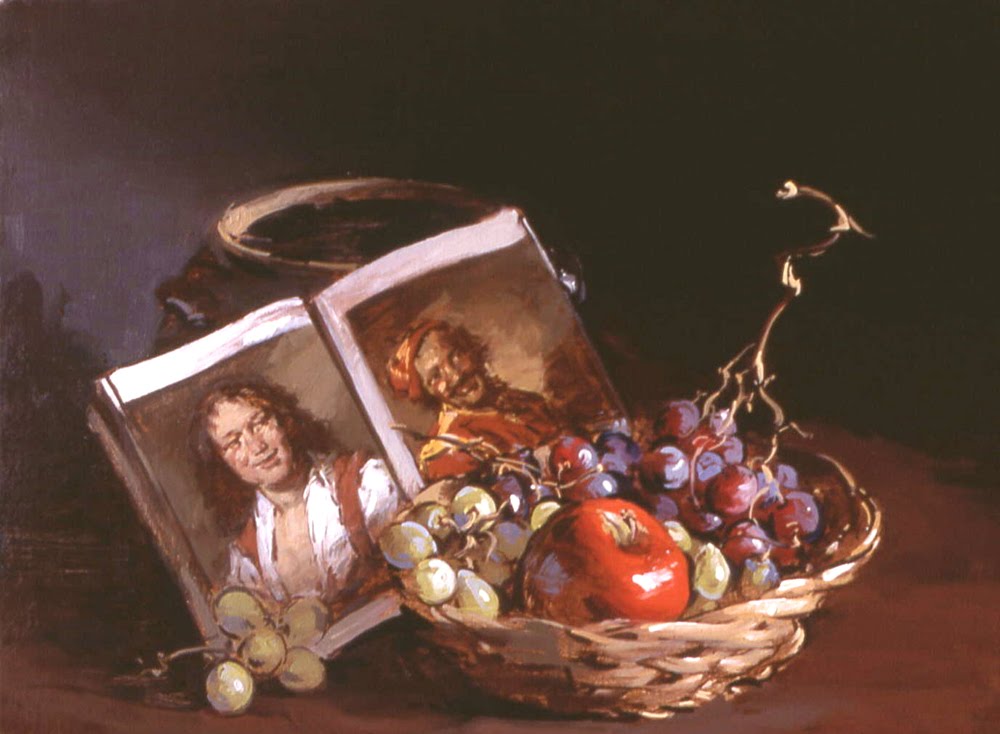
Hals and Fruit
16 x 20 Oil on Linen

Artistic experiences: part 3, the museum.
While visiting the home of one of my high school friends I saw two pictures on the wall which moved me very profoundly. I looked for them in the art books at the library the next day and found one was Rembrandt’s Girl with a Broom, the other was Frans Hals’ Bohemian Girl. They were cheap reproductions but a spell had been cast. Shortly after graduation I took myself to the Philadelphia Museum of Art. As far as I knew no one in my family had ever been to a museum, neither had any of my friends. In my uncultured world I was sailing into uncharted waters. I started up the enormous stairs leading to the museum, it seemed as if I were climbing Mount Olympus. I was in fact about to enter what would become for me the home of the gods. The first room I entered housed an early Renaissance altar, quite beautiful but I came to see paintings. The next room did not disappoint. I entered and stood before Rubens’ Prometheus Bound. I was frozen in my tracks. I had never seen or experienced anything like this before. A 7’ x 8’ tour de force with Prometheus tumbling out of the canvas while an eagle swoops in to peck at his liver. I had never perceived anything so terrifying and yet so beautiful, so powerful, expressive and compelling. I was unaware of my surroundings, nothing existed for me except this painting. My heart was pounding, my head swimming, I was transported to another dimension. I’m not sure how long I stood there but I knew my life had changed. At that moment, though I had not yet touched a canvas with a brush, I knew I was an artist…..

Monday, August 16, 2010

Apples and Pears
12 x 16 Oil on Panel

Artistic experiences: part 2, school days.
When I was in first grade my mother gave me a nickel each morning so I could buy a pint of cold milk at school to go with my peanut butter and jelly or baloney sandwich for lunch. I stopped at the corner store instead and bought a pack of baseball trading cards. When I got home I would take a piece of paper, a pencil and a few crayons and draw portraits of the ball players from the cards. This is my earliest memory of drawing. Later, in high school, the final project in my French class was to have a group of 4 students write a small newspaper in French. I was terrible at French and suggested to my group that instead of writing a story I would create a page of comics for our paper. They were thrilled because we were sure to be the only group with comics in our newspaper and I was happy because I could fill my page with drawings and had very little to translate. So there were Charlie Brown and Beetle Bailey, Blondie and Dick Tracy all beautifully drawn and speaking French. Apparently I did not translate “Good grief” properly but the teacher was very impressed with my drawings. I may be the only student in history to pass French class by drawing in French…..

Sunday, August 15, 2010

Golden Delicious
12 x 18 Oil on Linen

Artistic experiences: part 1, finger painting.
I grew up in what I refer to as a culturally deprived home. It was a nice home, in a small town with the kind of people you see in Norman Rockwell’s illustrations, but it was artistically uninspiring. There were no books in the house, except the bible. My main stimulation was the black and white TV with its 3 channels. Its sterile programming of Father Knows Best and Leave it to Beaver echoed my Catholic upbringing. My musical experiences were shaped by my sister watching American Bandstand and my parents taking in the adult music of Sing Along with Mitch and Lawrence Welk’s champagne music. The Ed Sullivan Show introduced me to the current cultural trends. The pictures on the wall were either family photos or something so uninteresting that I can not now recall. There were no paintings. I never knew anyone who painted, even as a hobby. My mother told me that growing up in Philadelphia she used to draw her friends as they played in the street but I never saw her draw. I remember my father made a drawing of a cowboy for me when I was very young, maybe 3 or 4. I was amazed that he could do this, but it never happened again. When I went to kindergarten they gave us finger paints and told us to fill up the paper with paint and make designs with our fingers. “This is really stupid” I thought to my young self, “Why can’t they teach me to draw a cowboy like the one dad did?”…..

Thursday, August 12, 2010

Festiva Maxima
14x16 Oil on Linen

Not far from where I live there is a beautiful historic estate called Hildene. It was built by Lincoln's son, Robert Todd Lincoln, in 1905. Behind the house there is a magnificent garden, known as the Hoyt Formal Garden. Some years ago the Friends of Hildene, who now oversee the estate, decided to have an art competition of paintings inspired by or painted in the garden. The top prize was $1000 and I was invited to be the juror. The resulting paintings were so wonderful they decided to repeat the competition the next year. This time I was able to participate. There are many varieties of peonies in the Hoyt garden, so I decided to paint a still life of peonies inspired by Hildene but from my garden. It was quite elaborate so I called it The Peony Symphony. I was delighted to be awarded First Prize at the opening. The next year I assumed I would not be in the running for a prize and decided to do a smaller piece. This time I worked in the garden painting a few Festiva Maxima blooms directly from the plant. I was alone in the garden with the estate gardener and we chatted cheerfully as we both worked. The painting was fresh and free and lively. I attended the opening to see who would get the top prize this year and was quite surprised to find I had won again. When my name was announced I heard another artist behind me whisper "again" and began to have thoughts of being pummeled by a gang of angry artists in the parking lot.....

Sunday, July 25, 2010

PAINTING OF THE MONTH

Pas de Deux
Oil on Linen
Image 10 x 8 - Framed 17 x 15

$1500

Another painting inspired by chamber music. This time the objects are not so much conversing as moving in unison. The music not quite so melodic as it is tonal. The content is less narrative, more poetic, less illustrative, more evocative. I hear it as a cello sonata, a tone poem by Debussey, add choreography and it becomes a pas de deux.....

The Painting of the Month is a special offer to my blog readers (click on the image for a larger view). This month Pas de Deux, which retails for $2400, is being made available for $1500 (includes shipping, VT residents add 6% sales tax). To purchase this piece contact me at thomastorak@gmail.com. Payment is by check only please, no credit cards. If you prefer you may make 3 monthly payments. This offer is available for 30 days from the date of this post.

Wednesday, July 21, 2010

Peonies in a Water Glass
14 x 16 Oil on Linen

I've been listening to a lot of chamber music recently. Mozart, Beethoven, Schubert, Brahms, trios, quartets, sextets...heaven. I love the intimacy of this music, I love the serious pieces and the playful, I love the conversations. It is so delightful to hear a violin play a melody, the viola respond, then the cello and piano voice their opinions before they all start talking at the same time and finally come to a resolution. Some artists might refer to small interiors as the chamber music of painting but I like to compose mine as still lifes. A few simple objects in conversation, they are often completed in one or two sittings. In Peonies in a Water Glass the flowers and their leaves, the water glass and the draperies all play their own parts beautifully yet move seamlessly in and out of conversation with each other. The rich blue drapery deeply moved by the delicacy of the peonies, the green stripe on the white cloth echos the color and rhythm of the leaves, the water glass hears them all and adds its own sparkling voice. All at once there is intimacy, profundity, playfulness and joy. Many artists think they need to be symphonic or operatic to be heard, often the louder the better. Others, like me, prefer to speak with more subtlety, with fewer voices, in trios and quartets and sextets.....

Saturday, July 17, 2010

Reynold's Farm
8 x 10 Oil on Linen

This is my favorite Frank Mason story. For me no one could paint atmosphere like Frank. He was the master of painting something he couldn't see with materials he didn't have. Although he was brilliant at painting atmosphere, he was not always quite so successful at explaining it to his students. One time he started a critique with a casual remark, “You need a tube of atmosphere paint,” then proceeded to rework the student's canvas showing him how to bring more light and air and space into his painting. But the lesson the student got was that he needed a tube of atmosphere paint. So after class he went downstairs to the League's store and asked for a tube of atmosphere paint. The fellow behind the counter, who had studied with Frank, asked “What class are you in?” “Frank Mason's class” he said proudly. “Oh I see” said the salesman, and then with a devilish grin added “Well, we're out of atmosphere paint. Why don't you go next door to Lee's, they might have some.” So he went to Lee's and said “I need a tube of atmosphere paint.” The salesperson seemed puzzled by this request but she checked through her list of supplies, then said “We don't carry that, why don't you try Sam Flax down on 53rd street.” So off he went to 53rd street where he was mercifully told that there was no such thing as a tube of atmosphere paint. He returned to class the next day and told us of his unsuccessful search and then added that he would never again fail to look for the atmosphere in his painting.....

Tuesday, June 29, 2010

Remembering Van Gogh
34 x 30 Oil on Linen

The American Heritage Dictionary defines Art as the conscious production or arrangement of sounds, colors, forms, movements or other elements in a manner that affects the sense of beauty. Britannica Online characterizes Art as the use of skill and imagination in the creation of aesthetic objects, environments, or experiences that can be shared with others. Various artists have offered more poetic definitions. "Art is the signature of civilizations" -Beverly Sills. "Art is the child of nature" -Henry Wadsworth Longfellow. "Art is the expression of the immortal part of man" -Ignace Paderewski. "Art is the escape from personality" -T.S. Eliot. Others are philosophical. "Art seems to me to be a state of soul more than anything else" -Marc Chagall. "Art is a revolt against man's fate" -Andre Malraux. "Art cannot be modern, art is timeless" -Egon Schiele. Some are cynical. "Art never expresses anything but itself" -Oscar Wilde. "Art is making something out of nothing and selling it" -Frank Zappa. "Art isn't something you marry, it's something you rape" -Edgar Degas. Others more positive. "Art is seduction, not rape" -Susan Sontag. "A work of art is the trace of a magnificent struggle" -Robert Henri. "Art is the triumph over chaos" -John Cheever. Some describe Art with humor. "Art isn't everything, it's just about everything" -Gertrude Stein. "You will think less of the Art, when you know the artist" -George Bernard Shaw. Others take it quite personally. "I feel strongly that the visual arts are of vast and incalculable importance, of course I could be prejudiced, I am a visual art" -Kermit the Frog. Perhaps my favorite definition is E.H. Gombrich’s non-definition, "There really is no such thing as Art, there are only artists"…..

Sunday, June 27, 2010

PAINTING OF THE MONTH

Serendipity
Oil on Linen
Image 16 x 20 - Framed 22 x 26
$2100

Some artists are so full of ideas about what to paint they could never complete them all in one lifetime. Others, though they may have great skills, are clueless about what to paint and are happiest when someone commissions them to paint something. I fall somewhere in the middle. I have many images that I want to commit to canvas but also like to be available for fresh inspirations. One painting frequently leads into the next one but occasionally the chain of thought is interrupted. At those times I often grab a few simple, familiar objects, take them to my studio and play with light and composition and color. Chopin might have called them études, Beethoven bagatelles, I like to think of them as serendipities....

The Painting of the Month is a special offer to my blog readers (click on the image for a larger view). This month Serendipity, which retails for $3200, is being made available for $2100 (includes shipping, VT residents add 6% sales tax). To purchase this piece contact me at thomastorak@gmail.com. Payment is by check only please, no credit cards. If you prefer you may make 3 monthly payments. This offer is available for 30 days from the date of this post.

Sunday, May 9, 2010

Spring Landscape
9 x 13 Oil on Panel

The Metropolitan Museum recently rediscovered a painting by Velazquez. The painting entered the Met collection in 1949 as a Velazquez Self Portrait. The origins of the painting are unknown, it first turned up in the 18th century in a German collection. It was initially thought to be a work by Van Dyck, then Velazquez, possibly Mazo, Velazquez again, then school of, workshop of, and finally Velazquez yet again. The sitter has been unknown, a self portrait and now unknown again. It was never really lost but the attribution was downgraded twice and it was finally hidden in storage for many years. Experts, curators and historians were clueless. It's as if the painting was in the witness protection program. Perhaps it saw a restorer overclean a masterpiece and then testified against him. It was given a new identity and relocated to the Met where it might easily blend into the museum's massive collection. That seems to have worked for quite a long time, it was restored twice without being discovered, but then someone in the museum recognized the piece and handed it over to the head of the restoration department who roughed it up a bit for being a snitch before hanging it back on a wall in the museum. It has now been publicly identified as by Velazquez again but not as a self portrait and, since its recent cleaning, is considered an unfinished portrait.....

Wednesday, May 5, 2010

Silver and Pink
20 x 25 Oil on Linen

My students are beginning to think I am the descendant of a cyclops. I am constantly telling them to see with their third eye. Situated on the forehead above and between the two eyes, the third eye is on the meridian between the left and right hemispheres of the brain. It is also known as the inner eye or the mind's eye, the eye of enlightenment, wisdom and knowledge. Your two physical eyes are not meant for painting I tell them, they are there for survival, constantly on the lookout for predators, for food, for sexual stimulation. So when we look at the model we see all the details, the eyes, the nose, the shoes, the fingernail polish. We study the gesture and attitude. We take in all these things to tell us if we are in danger or have found food or a mate. But the third eye is not interested in details, it takes in the whole of what is before it. It sees the model, the background, the room, the light and space as one. It is the eye of unity and harmony. Now there is no doubt that we want to know and express the individual characteristics of our sitter, but the sum of those details does not add up to a great painting. It is the oneness, the unity and harmony, the wisdom and enlightenment of the third eye that will turn a well painted head into an unforgettable portrait.....

Sunday, April 25, 2010

Oranges and Eggs
16 x 20 Oil on Linen

While driving my car last week I happened upon an interview with Stephen Sondheim on the radio. At some point he began to talk about his childhood. He grew up on the upper west side of Manhattan and apparently had a rather unhappy childhood. When his parents divorced he was sent away to the New York Military Academy, a college preparatory school with a military structure. The interviewer suggested that must have been difficult for him. No, Sondheim replied, it was a very good experience. The education was good and the military aspect of the school brought order and discipline to his unstructured life. Learning order was a very valuable lesson which has served him well in life, he said, because after all that's what art is, bringing order to chaos.....